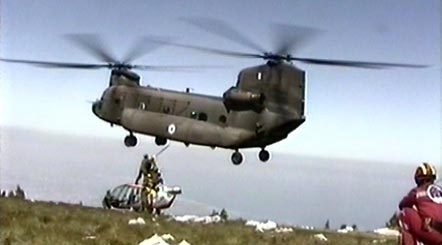
Μία βρετανική είδηση με άμεσο ελληνικό ενδιαφέρον από τον τομέα των αεροπορικών ατυχημάτων. Tον Ιούνιο του 1994, συνετρίβη ένα ελικόπτερο τύπου Σινούκ των ενόπλων δυνάμεων της Μεγάλης Βρετανίας, με τραγικό αποτέλεσμα τον θάνατο όλων των επιβαίνοτων, συμπεριλαμβανομένων των 25 εμπειρογνωμόνων σε θέματα ασφάλειας της Βόρειας Ιρλανδίας.
Μέχρι πρότινος, τρεις έρευνες έχουν αποτύχει να προσδιορίσουν την αιτία της συντριβής, αλλά πρόσφατα προέκυψαν νέα στοιχεία που αναφέρουν πως το λογισμικό των ηλεκτρονικών υπολογιστών μπορεί να προκάλεσε τη συντριβή του ελικοπτέρου Chinook Mk 2 helicopter ZD576 στην περιοχή Mull of Kintyre, στο οποίο 29 άνθρωποι συνολικά έχασαν τη ζωή τους. Το ελικόπτερο καταστράφηκε ολοσχερώς κατά τη συντριβή.
Η επίσημη έρευνα της RAF για το το περιστατικό κατέληξε στο συμπέρασμα ότι το ελικόπτερο είναι αξιόπλοο, και διαπιστώθηκε ότι οι χειριστές του ενήργησαν με αμέλεια.
 Greek National Pride
Chinook ZD576
• This particular type of Chinook (HC2) had a long history of problems which were known to the authorities and in particular at Boscombe Down immediately prior to the accident. The very aircraft itself had also encountered serious problems prior to the day of the accident.
• It is a common understanding that ZD576 was not a serviceable aircraft in the true sense and had this been a civilian Chinook it would never have been allowed to depart. In civil aviation we have in our operational manual what we call allowable deficiencies. This basically is a list of go or no go items.
• The weather was typical coastal type weather with some hills shrouded in cloud or mist and it was obvious from the account of the Mr. Holbrook (the boat skipper) that visibility at sea level was reasonable. From my experience the cloud/mist on the coastal hills is continuously swirling around with a fluctuating cloud base. The fact that the lighthouse keeper did not have good visibility is because he was at a higher level and in a totally different position. Mr. Holbrook could see the surrounds of the lighthouse and the approaching helicopter.
• As an expert in aviation security it is not normal for such people as Royal Family, VIP, and CEO/Directors to travel on the same aircraft in such number for obvious reasons. Why was such a high profile group allowed to travel on one helicopter?
• The Chinook departed Aldergrove as a VFR flight and did transit the northeast part of Northern Ireland before its sea transit to the Mull of Kintyre without incident. It is therefore obvious that no matter what was programmed into the computer the flight was still carried out under VFR rules with the crew having the ability to adjust accordingly.
• The crew would have selected on their Sat Nav (whilst still at Aldergrove) their first waypoint which was A and also programmed in their second waypoint B etc.
• As the crew visually monitored the approaching Mull of Kintyre headland they would have been extremely alert and ready to call ATC with a position report i.e. waypoint A and at the same time selected waypoint B. If in those final moment the crew could see that their select waypoint was putting their aircraft into danger then again that would have de activated and corrected their course to fly up the western side of the Mull of Kintyre peninsula.
• A call to ATC was made but no response was given and one has to ask why not as this was a very special flight and the RAF would have been carrying out flight following procedures. One would also expect this to be their position report, ahead of the turn, having also gone visual with the lighthouse.
• One can therefore only assume at this moment something catastrophic occurred that took away the ability of the crew to control the helicopter. This can only lead to five possible causes – Catastrophic Failure of the control mechanism – Contamination of the Hydraulic System – FADEC failure – Interference to the aircraft by either outside or inside persons – Crew Error.
• It is also common knowledge that the Mull of Kintyre is in itself a very secretive location used as a testing ground for advanced (next generation) high tech military aircraft as well as US Navy Seals. One would therefore assume that the area was monitored continuously by both the RAF and the US with their usual array of sophisticated tracking systems and radar etc.
• There would have been other fishing boats around and one could ask the question how much effort was put into obtaining witnesses, how was the screening carried out and were all witnesses taken to their location on that day to display, explain or visually show what they saw or heard etc.
• Why wasn’t the possibility of inside or outside sabotage or external control of the aircraft looked at more deeply? This has been discussed at other aircraft accidents but did not play a significant part in this inquiry. The status and importance of the passengers onboard would have certainly made this a distinct possibility.
In regard to the latter i.e. that of sabotage; I have myself received vital information, from a very senior ex intelligence officer, that this was an inside job. It was during a very lengthy conversation on the 4th of August 2010 that this person disclosed that the Chinook was not an accident but one that had been planned from the office where the intelligence officer had previously worked.
I immediately discussed this with my friend (ex RAF) and carried out my own research. It was only last week that I again made contact with him and told him, that in my opinion, the investigation was a cover up in some way and one would have to take such evidence into consideration. He advised me that if I do not take this up with the police immediately, then he will. We both then proceeded to our local police station to report the contents of this telephone call.
The contents of the telephone call were noted by the Derby Police HQ, St Mary’s Wharf, Derby under incident number 620 dated 07/10/2010. Both Gordon Bowden and I are still waiting for a fully recorded interview, to be taken under oath, which to date still has not taken place. In my opinion it is therefore vital that my informant be interviewed to clarify what was said and for that person to substantiate the comments made.
Peter Eyre
Aviation Consultant – Senior Operations Officer Airline/Helicopter – SAR Coordinator.