Το μηνιαίο περιοδικό του Υπουργείο Εξωτερικών των ΗΠΑ με την επωνυμία ‘STATE’ (U.S . DEPARTMENT OF STATE – April 2010), έχει αφιέρωμα στο τεύχος Απριλίου στα Σκόπια με τίτλο εξωφύλλου «Macedonia’s Pearl of the Balkans» (Το μαργαριτάρι της Μακεδονίας των Βαλκανίων).
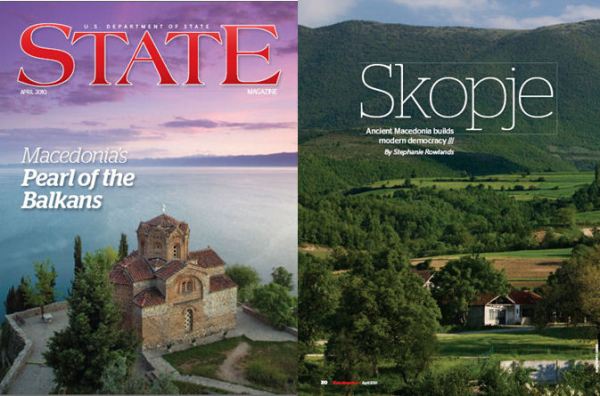
Κλικάρετε την εικόνα ώστε να δείτε ολόκληρο το «αφιέρωμα» στο κράτος μόρφωμα (σελ.20-25)
Για σχετικά σχόλια προς τους ανιστόρητους Αμερικάνους, κλικάτερε την εν λόγω πρόταση και δώστε τα στοιχεία σας (ευκαιρία είναι να σας κάνουν και μία …ακτινογραφία)
Η συντάκτης είναι η Stephanie Rowlands που αναφέρεται ως «The author is the wife of Ryan Rowlands, public affairs officer at the U.S. Embassy in Skopje» Η συγγραφέας είναι η γυναίκα του Ryan Rowlands,αξιωματούχου λαϊκών υποθέσεων στην αμερικανική πρεσβεία των ΗΠΑ στα Σκόπια.
Στο μηνιαίο περιοδικό του Υπουργείο Εξωτερικών των ΗΠΑμε την επωνυμία ‘STATE’ (U.S . DEPARTMENT OF STATE-April 2010 Issue Number 544) , έχει αφιέρωμα το μήνα αυτόν στα Σκόπια με τίτλο εξωφύλλου «Macedonia’s Pearl of the Balkans» ( Το μαργαριτάρι της Μακεδονίας των Βαλκανίων).
Το κεντρικό αφιέρωμα είναι στη σελίδα 20 και εξής (το ‘σαλόνι’ του περιοδικού) όπου τιτλοφορείται Skopje – “Ancient Macedonia builds modern democracy” – Η αρχαία Μακεδονία δημιουργεί σύγχρονη δημοκρατία».
Ο συσχετισμός των αρχαίων Μακεδόνων με τους σημερινούς σλαβοσκοπιανούς.
Η συντάκτης επιχειρεί να συνδέσει, ανιστόρητα, τους σύγχρονους κατοίκους της περιοχής των Σκοπίων με τους αρχαίους Μακεδόνες, γελοιοποιώντας έτσι τη σοβαρότητα του κειμένου και γνωστοποιεί συγχρόνως, στους σοβαρούς αναγνώστες, την ανύπαρκτη ιστορική της γνώση. Και αυτό το επιχυγχάνει με μεγάλη επιτυχία καθώς προβαίνει στην απόπειρά ταύτισης των Σλαβομακεδόνων με τους αρχαίους Μακεδόνες…
Γράφει στην εισαγωγή του κειμένου της:
«Μακεδονία. Η λέξη θυμίζει εικόνες των αρχαίων πολιτισμών, τους άνδρες με χλαμύδες και σανδάλια που φέρουν δόρατα και ασπίδες. Θυμίζει, ακόμη, τη σύγχρονη ευρωπαϊκή ιστορία, την εμφάνιση και την ξαναχάραξη των εθνών, όταν εξασθένισε η Οθωμανική Αυτοκρατορία.
Η γεωγραφική περιοχή της Μακεδονίας, ένα φυσικό σταυροδρόμι, στη διάρκεια των αιώνων κατακτήθηκε από βασίλεια και αυτοκρατορίες. Σήμερα, μεγάλα τμήματα της ιστορικής Μακεδονίας βρίσκονται εντός των ορίων των γειτονικών χωρών.
Η «Δημοκρατία της Μακεδονίας» έχει ως στόχο να αναπτύξει περαιτέρω τη βαθιά παράδοση της ανεκτικότητας , της μάθησης και της ειρηνικής ανάπτυξης. Το ποικίλο μίγμα των πολιτισμών, θρησκειών, γλωσσών και η γεωγραφία, κάνει αυτή τη χώρα ελκυστική για πολλούς Αμερικανούς».
Η συντάκτης ακολουθεί σαφώς την αλυτρωτική πολιτική των Σκοπίων και εντείνει την ιστορική παραπλάνηση των ίδιων των Σκοπιανών.
Πιο κάτω θα σημειώσει τα εξής χρησιμοποιώντας το πολλοί Βούλγαροι ( Many Bulgarians ) και το πολλοί Σέρβοι (many Serbians ), ενώ η αλήθεια είναι το βουλγαρικό κράτος και το σερβικό κράτος. Δεν σταματά εκεί αναφέρεται στην Ελλάδα χωρίς να εξηγήσει τους λόγους της Ελλάδας ή την ιστορική αλήθεια περί των αρχαίων Μακεδόνων που τους κάνει …Σλάβους!
Έτσι γράφει:
«Πολλοί Βούλγαροι έχουν την άποψη πως η ‘μακεδονική γλώσσα’ δεν είναι διαφορετική από τη βουλγαρική και πολλοί Σέρβοι απορρίπτουν την ανεξαρτησία της «Μακεδονικής Ορθόδοξης Εκκλησίας». Αλλά η πλέον αμφισβητούσα σε όλα είναι η Ελλάδα που διαμαρτύρεται για το όνομα της χώρας.
Η διαφορά με την Ελλάδα για το συνταγματικό όνομα της «Μακεδονίας» έχει εμποδίσει την ένταξη της, στους Ευρω-ατλαντικούς θεσμούς. Από τότε που η χώρα ανακύρηξε την ανεξαρτησία της το 1991, η Ελλάδα εκφράζει την αντίθεσή της στη χρήση του ονόματος «Μακεδονία» με αποτέλεσμα την αναβολή της ένταξης της πΓΔΜ στο Βορειατλαντικό Οργανισμό και στην αναβολή των ενταξιακών διαπραγματεύσεων με την Ευρωπαϊκή Ένωση.
Η «Μακεδονία» εξακολουθεί να αναφέρεται στα Ηνωμένα Έθνη και στους άλλους διεθνείς οργανισμούς, ως πρώην Γιουγκοσλαβική Δημοκρατία της Μακεδονίας. Οι Ηνωμένες Πολιτείες αναγνώρισαν επίσημα τη Μακεδονία από το 2004».
Η κακιά Ελλάδα, λοιπόν, είναι σύμφωνα με τους αμερικανούς αυτή που εμποδίζει το σύγχρονο κράτος των αρχαίων Μακεδόνων (sic) να ενταχθεί στους διεθνείς οργανισμούς.
Και τα καημένα τα Σκόπια ανέχονται που κομμάτια της ιστορικής Μακεδονίας βρίσκοναι στην κατοχή των γειτονικών χωρών… Kαρτερικά ανέχονται…
Έτσι για να γνωρίζουμε με ποιον μιλάμε… U.S. Department of State…
«Πές μου το φίλο σου, να σου πω ποιος είσαι», λέμε εντό στο Ελλάντα, εμείς οι …κατακτητές…
http://echedoros-a.blogspot.com
ΤΟ ΔΙΚΟ ΜΑΣ EMAIL ΠΡΟΣ ΤΟ ΥΠΟΥΡΓΕΙΟ ΤΩΝ ΗΠΑ ΣΑΝ BLOG
One comment about your headline also the oblation in the “US DEPARTMENT OF STATE MAGAZINE” with title “Macedonia’s Pearl of the Balkans”
Att. Mrs. Stephanie Rowlands
Dear Mrs. Rowlands,
First of all we would like to introduce myself. My name is Lukas Symperas and I come from Greece.
I have read carefully your oblation with the title “Macedonia’s Pearl of the Balkans” (from 20th page up to 25th page) of the last edition’s “US DEPARTMENT OF STATE MAGAZINE” – April 2010.
Please accept to read some very important information that I am sending you, also please accept to listen us in order to “uncover” some serious historical inaccuracies of the country that it called… the “Republic of Macedonia”.
At the beginning, please read the first of the two following letters. The firstly below letter is written by 200 professors was sent in May 18th 2009 to…
The Honorable Barack Obama
President, United States of America
White House
1600 Pennsylvania Avenue, NW
Washington, DC 20500
Dear President Obama,
We, the undersigned scholars of Graeco-Roman antiquity, respectfully request that you intervene to clean up some of the historical debris left in southeast Europe by the previous U.S. administration.
On November 4, 2004, two days after the re-election of President George W. Bush, his administration unilaterally recognized the “Republic of Macedonia.” This action not only abrogated geographic and historic fact, but it also has unleashed a dangerous epidemic of historical revisionism, of which the most obvious symptom is the misappropriation by the government in Skopje of the most famous of Macedonians, Alexander the Great.
We believe that this silliness has gone too far, and that the U.S.A. has no business in supporting the subversion of history. Let us review facts. (The documentation for these facts [here in boldface] can be found attached and at: http://macedonia-evidence.org/documentation.html
The land in question, with its modern capital at Skopje, was called Paionia in antiquity. Mts. Barnous and Orbelos (which form today the northern limits of Greece) provide a natural barrier that separated, and separates, Macedonia from its northern neighbour.
The only real connection is along the Axios/Vardar River and even this valley “does not form a line of communication because it is divided by gorges.»
While it is true that the Paionians were subdued by Philip II, father of Alexander, in 358 B.C. they were not Macedonians and did not live in Macedonia. Likewise, for example, the Egyptians, who were subdued by Alexander, may have been ruled by Macedonians, including the famous Cleopatra, but they were never Macedonians themselves, and Egypt was never called Macedonia.
Rather, Macedonia and Macedonian Greeks have been located for at least 2,500 years just where the modern Greek province of Macedonia is. Exactly this same relationship is true for Attica and Athenian Greeks, Argos and Argive Greeks, Corinth and Corinthian Greeks, etc.
We do not understand how the modern inhabitants of ancient Paionia, who speak Slavic – a language introduced into the Balkans about a millennium after the death of Alexander – can claim him as their national hero. Alexander the Great was thoroughly and indisputably Greek. His great-great-great grandfather, Alexander I, competed in the Olympic Games where participation was limited to Greeks.
Even before Alexander I, the Macedonians traced their ancestry to Argos, and many of their kings used the head of Herakles – the quintessential Greek hero – on their coins.
Euripides – who died and was buried in Macedonia– wrote his play Archelaos in honor of the great-uncle of Alexander, and in Greek. While in Macedonia, Euripides also wrote the Bacchai, again in Greek. Presumably the Macedonian audience could understand what he wrote and what they heard.
Alexander’s father, Philip, won several equestrian victories at Olympia and Delphi, the two most Hellenic of all the sanctuaries in ancient Greece where non-Greeks were not allowed to compete. Even more significantly, Philip was appointed to conduct the Pythian Games at Delphi in 346 B.C. In other words, Alexander the Great’s father and his ancestors were thoroughly Greek. Greek was the language used by Demosthenes and his delegation from Athens when they paid visits to Philip, also in 346 B.C.
Another northern Greek, Aristotle, went off to study for nearly 20 years in the Academy of Plato. Aristotle subsequently returned to Macedonia and became the tutor of Alexander III. They used Greek in their classroom which can still be seen near Naoussa in Macedonia.
Alexander carried with him throughout his conquests Aristotle’s edition of Homer’s Iliad. Alexander also spread Greek language and culture throughout his empire, founding cities and establishing centers of learning. Hence inscriptions concerning such typical Greek institutions as the gymnasium are found as far away as Afghanistan. They are all written in Greek.
The questions follow: Why was Greek the lingua franca all over Alexander’s empire if he was a “Macedonian”? Why was the New Testament, for example, written in Greek?
The answers are clear: Alexander the Great was Greek, not Slavic, and Slavs and their language were nowhere near Alexander or his homeland until 1000 years later. This brings us back to the geographic area known in antiquity as Paionia. Why would the people who live there now call themselves Macedonians and their land Macedonia? Why would they abduct a completely Greek figure and make him their national hero?
The ancient Paionians may or may not have been Greek, but they certainly became Greekish, and they were never Slavs. They were also not Macedonians. Ancient Paionia was a part of the Macedonian Empire. So were Ionia and Syria and Palestine and Egypt and Mesopotamia and Babylonia and Bactria and many more. They may thus have become “Macedonian” temporarily, but none was ever “Macedonia”. The theft of Philip and Alexander by a land that was never Macedonia cannot be justified.
The traditions of ancient Paionia could be adopted by the current residents of that geographical area with considerable justification. But the extension of the geographic term “Macedonia” to cover southern Yugoslavia cannot. Even in the late 19th century, this misuse implied unhealthy territorial aspirations.
The same motivation is to be seen in school maps that show the pseudo-greater Macedonia, stretching from Skopje to Mt. Olympus and labeled in Slavic. The same map and its claims are in calendars, bumper stickers, bank notes, etc., that have been circulating in the new state ever since it declared its independence from Yugoslavia in 1991. Why would a poor land-locked new state attempt such historical nonsense? Why would it brazenly mock and provoke its neighbor?
However one might like to characterize such behavior, it is clearly not a force for historical accuracy, nor for stability in the Balkans. It is sad that the United States of America has abetted and encouraged such behavior.
We call upon you, Mr. President, to help – in whatever ways you deem appropriate – the government in Skopje to understand that it cannot build a national identity at the expense of historic truth. Our common international society cannot survive when history is ignored, much less when history is fabricated.
Please follow the below site in order to see and all the signatures.
http://macedonia-evidence.org/obama-letter.html
THE SECOND LETTER.
Macedonian Names of 14th Century reveal the Greek Character of Macedonia.
Examination of Macedonian Names of 14th Century in the Themes of Thessalonike and Strymon reveals the Greek Character of Macedonia. THE study of names can tell us a great deal about a society, for names are primarily a means of social identification.
People identify themselves or are identified by others in ways which may reveal kinship patterns, migration movements, economic differentiation or social stratification, superstitious beliefs. Children may habitually be named after the paternal or maternal grandparents, after parents or Siblings. Names may show adherence to a religion or to superstition: the Byzantine parents who named their children Aporicto or Evreto (“rejected” and “founding”) were trying to deceive death, while a man named Prousenos testified to his parents’ nostalgia for a lost homeland in Asia Minor. Proper or family names which continue over more than one generation can show the interest of the family itself or of the state in identifying people over time.
The Byzantine peasants in Macedonia of the fourteenth century were commonly identified by a baptismal or given name and some other form of identification: a profession, an indication of geographical origin, a nickname, or an indication of relationship to someone else. Both the given names and the “family” names are of interest here.
Some names are very common. Men are often named Nikolaos, Demetrios, Konstantinos, Ioannes, Vasileios, Michael, Manouel, Stamates, Theodoros. Somewhat less frequent are the names Modestos, Nikephoros, Theiotokios, Kyriakos, Foteinos, Athanasios, Petros, Alexios, Stefanos, Xenos. Most of these, with the exception of Xenos, Alexios, Modestos and Foteinos, are also common modern Greek names. On the other hand, Evangelos and Eleutherios, which occur frequently in modern Greece, are rare in the fourteenth century.
Women were most often called Maria and Anna (as in modern Greece), Zoe, Arete, Chryse, Argyre, Kale, Theodora, Eirene, Xene, Eudokia, Elene, Georgia, and less frequently Vasilike, Ioannousa, Kyriakia, Rossana or Rossa, Siligno, Sophia, Foteine, Theophano, Stammatike, and Marina. The name Aikaterine, one of the commonest modern Greek names, is very rarely encountered.Some Christian names are very similar to those found among the peasants of the Morea in the same period. They fall into three categories:
(1) Those referring to God, the Virgin, and Christ;
(2) Saints’ names; and
(3) Those deriving from feasts of the Christian calendar.
In the first category, we find Theodoros, Theodora (“gift of God”), Manouel from Emmanuel (the popular form Manolis does not appear in our documents), Theochares, Theiotokios (from the Theotokos, or “mother of God”), Panagiotes, from the adjective of the Virgin which qualifies her as “most saintly,” and Christina. Maria, of course, was a very common name.
The saints most often celebrated in peasant names were Theodore, Demetrius, and George (all military saints), Athanasius and Basil (the fourth-century church fathers), Constantine, the first Christian Emperor, and Helena, his mother. St. Peter is frequently represented, and the name of his assistant, Andronicus, appears occasionally.
A whole series of baptismal names consists of toponymics, something which one would not expect. Giving a child the name of a city or an island must mean that the family had had recent connections with the area referred to. In all three apographai under discussion, the greatest number of toponymies comes from Macedonia itself but, of course, outside the domain in which these families are found. This is an expected and logical situation. It simply means that the population of mobile one, moved more easily within rather confined boundaries. Names like Fourneiotes, Kasandrenos, Melenikeiotes, Ravenikiotes, Didymoteichites, Zigniotes indicate that the families had migrated within Macedonia from one domain and one region to another.
Immigration from the rest of Greece, as suggested by names such as Thebaios, Korinthios, Moraites, could be as old as the Latin occupation,but has no reason to be; it is more likely that the emigration in question followed the reestablishment of Byzantine power in Macedonia, and perhaps even the reestablishment of the Empire at Constantinople. Immigrants from the islands of the Aegean (that is, people bearing the names Lemnaios, Nesiotes, Naxiotes) probably came to Macedonia in the second half of the thirteenth century, after the wars of Michael VIII with the remaining Latin states had made life on the islands uncertain.
Some names are obviously of foreign origin, of these mostly are Slavic but also French, Italian and Spanish. Dragos, Draganos, Slanna, Tobranna, Dragna, Zougla, Malha, Merzana, Volkanos, Tobromeros, are all Slavic names. Imbert the Franc(“Μπέρον ο Φράγγος,”) was probably of French origin, while Nikephoros Idalkos, son of Dominick, was the offspring of a Spaniard, perhaps a member of the Catalan Company who had for some reason remained in Macedonia after the invasion of the region by Catalan mercenaries in 1307-1309.
An examination of the households which have a timeseries from 1300-1301 to 1341 reveal that:
(a) Theme of Thessalonike
The Slavic Names constitutes Only 8% out of the total during 1300-1301
The Slavic Names constitutes Only 5% out of the total during 1320-1321
The Slavic Names constitutes Only 3% out of the total during 1338-1341
(b) Theme of Strymon
The Slavic Names constitutes Only 26% out of the total ca. 1316
The Slavic Names constitutes Only 16% out of the total ca. 1325
The Slavic Names constitutes Only 30% out of the total ca. 1341
It is characteristic that those who from time to time are designated as Μακεδόνες (=Macedonians) are always members of Byzantine society or the Byzantine army, speaking the same language and apparently following the same faith, and that they never appear to turn, as the head of a certain group, against the Byzantine state.
This category does not appear to include the more recent immigrants to Macedonia, evidently because they retained their own ethnic particularity (language, religion, culture, etc.) and, more important still, their independence from the Byzantine rule. Thus, for example, in no case could any Bulgars, Slavs or Turks who were known to have settled in the region after a certain period (and who, indeed, became the permanent residents) ever be described as Μακεδόνες (=Macedonians).
(Please, excuse me that I disturb you. For you maybe is only one article, but for us is our history)
Sincerely,
Lukas Symperas – Λουκάς Συμπεράς (Διαχειριστής του Greek National Pride)
Το δεύτερο «γράμμα» το είχα δει πριν μήνες στο http://akritas-history-of-makedonia.blogspot.com/
 Greek National Pride
Έπρεπε να στείλεις email στο USA ώστε να μάθουμε τελικά το επώνυμο σου Κε Λουκά?
Αν σου πω Luxor πως το πραγματικό μου ονοματεπώνυμο είναι αυτό που άφησα στο email θα με πιστέψεις?
Αν δεν με πιστέψεις να ξέρεις ότι σφάλεις 100% (χαχαχαχαχα)
Φιλικά / Λουκάς Συμπεράς (Διαχειριστής του Greek National Pride)
Κάνε κλικ για να αποκτήσεις πρόσβαση 138927.pdf
Διαβάστε το ολόκληρο.
Η ΑΠΑΝΤΗΣΗ ΜΟΥ ΣΤΗ ΚΥΡΙΑ ROWLANDS
Dear Mrs Rowlands
Macedonia and Ancient Macedonia is a Historic place that comes from the famous Greek History and from the famous Greek Land known as Greece or Hellas.
It has 3000 years of history and more.
Alexander the Great was Greek as his father Fillipos and his mother and all relatives.
Macedonia is Greek as a historical and geographical area and the myth that Ancient or Modern Macedonia belongs to FYROM and Scopje belongs to all those who want to establish a new islamic country in the heart of Balkans by using the Greek symbols and the Greek history.
Mrs Rowlands,you have a history of 200 years in the U.S.
We, Greeks have a glorified history, famous in the entire world since then and our history of 3500 years and more never changes.Never !
Muslems and Slavs were those that lived in the region known as FYROM since 1300 A.C.
What common could they have Mrs. Rowlands with Greece and Macedonia ?
Did anyone tell you about Tito’s dictatorship,did anyone tell you about Yugoslavia or about some slavs and gypsies who came to Balkans in the 8th century ?
Mrs Rowlands read history please before you write wrong historical facts that somebodies dictate in order to acquire a cultural base that will support a new country without having anything else except the tools for change the Greek history that it is impossible to change for thousands of years , precisely because the proofs, something that do not have those who want to name Macedonia a place that is quite different from Greece,ancient Greece ,history,culture,civilization and many others !
There is no ethnic group known as Macedonian outside of Greek borders.Macedonians is only a local group of people in Greece,in Bulgaria and in ex-Yugoslavia known as Skopje and there is no country with a name MACEDONIA.
Macedonia is a geographical region that is shared between three countries (Greece who has the historical heritage and the historical region of Macedonia,FYROM and Bulgaria as devited pieces of Macedonian land).
Now,the gov of Skopje want to name their land Macedonia,why not Bulgarians to do the same and why not Greeks to do the same as a part of Greece ?
Don’t you think its quite idiot and fool ?
If Greece, hypothetically,wanted to change the name Peloponissos to California or New York for example what would be probably your reaction as a citizen of the United States, Mrs Rowlands ?
For the same reason there is no Macedonian language but only Slavian,Roman and Turkish in this part of land.
Macedonian language is the ancient Greek language ,its the same my dear !
Its obvious that your article serves political interests differently I cannot believe that before you wrote it you did not attend to learn history. In every case you are unread and need Greek and European history intensive courses. Anything other is political, economic and diplomatic compromise that serves interests.
Thank God ,Americans,Europeans,Asians,Australians and even Africans , know Greek history !
The globalisation does not know history but this is not fortunately a state or continent and it might be consolidated only if its recognizes the history of each country and each population separately, differently it will fail! This is what you must say my dear lady in all those that you know .
Have a nice day !
why are you people so preoccupied with the name macedonia.is it because you have absolutely nothing else to offer the world but your past? and isn’t an insult to call today’s tzatziki breath, chronic complaining european parasites descendants of pericles and aristotele?
Dear John,
we are preoccupied with the name macedonia because this a part of our history.
Would you like to start a negotiation (between you and me) for your house? I am serious interested in take your house free of charge.
Maybe we don’t have anything to offer to the world except our past, but the problem for you is that you don’t have absolutely anything to offer the world during a thousand years.
Finally I am serious interest in know, where are you come from in order to reply you with the necessary details.
my dear friend i am greek (gennithika stin athina,kypseli, odos agias zonis 24)but i got out of that miserable place first time i got the chance. as for your information it is greece that has nothing to offer the last thousand years. if i remember correctly a thousand years ago greece was nothing more than a backward province of the byzantine empire full of uneducated and superstitious goat herders.
dropi sas na kremeste apo ta archidia ton arhaion anikanoi karagiozides.
Αφού είσαι Έλληνας προτιμώ να μιλάω στη γλώσσα μας, μιας και τα Αγγλικά δεν τα μιλάω καλά όσο εσύ.
Αν και ανίκανος καραγκιόζης όπως λες, εγώ θα σου πω πως είναι δικαίωμα σου να πιστεύεις ότι θέλεις, ωστόσο τα εθνικά θέματα μπορεί για σένα να μην έχουν καμία σημασία αλλά για πολλούς άλλους έχουν.
Να ξέρεις πως εμεις οι ανίκανοι καραγκιόζηδες θα προσπαθήσουμε μία μέρα να κρατήσουμε Ελληνική τη Κυψέλη και το σπίτι που γεννήθηκες, αν και πολύ πιθανόν να μην σε ενδιαφέρει και καθόλου.
ΤΙ ΛΕΤΕ ΚΥΡΙΑ ΜΟΥ,ΜΠΟΡΕΙ,ΝΑΙ, ΕΧΕΤΕ ΔΙΚΑΙΟ,ΟΜΩΣ, ΑΝ ΕΙΝΑΙ ΝΑ ΠΡΟΣΦΕΡΟΥΜΕ,ΔΥΣΤΥΧΙΑ-ΤΡΟΜΟ-ΠΟΝΟ, ΚΑΙ ΤΟΣΑ ΑΛΛΑ ΚΑΛΑ ΠΟΥ ΠΡΟΣΦΕΡΕΙ,Η ΝΕΑ ΣΑΣ ΠΑΤΡΙΔΑ , ΑΜΕΡΙΚΗ ,ΤΟΤΕ ΔΕΝ ΘΕΛΟΥΜΕ ΝΑ ΠΡΟΣΦΕΡΟΥΜΕ ,ΑΛΛΟ,ΔΕΝ ΜΑΣ ΕΜΕΙΝΕ ΤΙΠΟΤΑ ΑΛΛΟ,ΕΔΩ ΚΑΙ ΠΕΝΗΝΤΑ ΧΡΟΝΙΑ. Η ΝΕΑ ΣΑΣ ΠΑΤΡΙΔΑ,ΜΙΑΣ,ΚΑΙ ΓΝΩΡΙΖΕΤΕ ΑΠΟ ΙΣΤΟΡΙΑ,ΜΠΟΡΕΙΤΕ ΝΑ ΜΑΣ ΠΕΙΤΕ,ΠΟΣΑ ΔΙΣ ΔΟΛΑΡΙΑ,ΜΑΣ ΠΗΡΑΤΕ ΓΙΑ ΕΞΟΠΛΙΣΜΟΥΣ,ΠΟΥ ΜΑΣ ΕΠΙΒΑΛΛΕΤΕ, ΝΑ ΚΑΝΟΥΜΕ,ΜΕΣΩ ΤΩΝ ΜΑΚΑΚΩΝ ΣΤΡΑΤΟΚΡΑΤΩΝ ΤΗΣ ΑΓΚΥΡΑΣ,ΜΑΣ ΨΕΚΑΖΕΤΕ ΚΟΥΤΟ-ΥΓΡΟ,ΜΕ ΤΑ ΑΕΡΟΠΛΑΝΑ ΣΑΣ ΝΑ ΧΑΖΕΨΟΥΜΕ, ΕΜΕΙΣ ΕΔΩ,ΕΙΜΑΣΙΕ Η ΜΑΚΑΔΟΝΙΑ, ΕΙΝΑΙ ΔΙΚΗ ΜΑΣ, ΕΙΣΤΕ ΑΙΜΟΣΤΑΓΕΙΣ,ΕΙΣΤΕ ΚΑΙ ΠΑΡΑΓΟΝΤΕΣ ΨΕΥΤΟΚΡΑΤΗΔΙΩΝ, ΑΛΛΑΞΕΤΕ ΤΑ ΣΧΕΔΙΑ ΣΑΣ,ΠΕΡΑΣΕ, ΚΑΙ Ο ΧΙΤΛΕΡ ΑΠΟ ΔΩ,ΑΥΤΟ ΤΟ ΞΕΡΕΤΕ,ΜΟΝΟ ΒΙΑ ΞΕΡΕΤΕ ΝΑ ΠΑΡΑΓΕΤΕ,ΓΙΑ ΝΑ ΤΑ ΟΙΚΟΝΟΜΑΤΕ ΕΚΕΙ ΣΤΗΝ ΝΕΑ ΣΑΣ ΠΑΤΡΙΔΑ, ΓΙΑ ΠΕΙΤΕ ΚΑΙ ΕΜΑΣ ΕΔΩ,ΑΦΟΥ ΞΕΡΕΤΕ ΑΠΟ ΙΣΤΟΡΙΑ, Η ΧΩΡΑ ΣΑΣ ΑΜΕΡΙΚΗ. ΤΗ ΠΡΟΣΦΕΡΕΙ ΑΠΟ ΤΑ ΓΕΝΝΟΦΑΣΚΙΑ ΤΗΣ,ΜΕΧΡΙ ΣΗΜΕΡΑ ΕΚΤΟΣ ΑΠΟ ΛΟΥΤΡΟ ΑΙΜΑΤΟΣ,ΑΝΑ ΤΟΝ ΠΛΑΝΗΤΗ,ΕΧΕΤΕ ΕΣΕΙΣ ΠΟΛΙΤΙΣΜΟ,ΕΧΕΤΕ ΠΥΡΗΝΙΚΑ,ΕΧΕΤΕ ΜΑΦΙΑ,ΑΥΤΑ ΠΡΟΣΦΕΡΕΤΕ ΕΣΕΙΣ ΣΤΟΝ ΚΟΣΜΟ ΤΟΥ ΣΗΜΕΡΑ,ΤΟ ΙΔΙΟ ΕΙΝΑΙ, ΚΥΡΙΑ,ΕΛΛΗΝΟΑΜΕΡΙΚΑΝΑ Η ΕΛΛΑΔΑ,ΑΜΕΡΙΚΗ,Η ΧΙΤΛΕΡΙΚΗ.-
Μια ερωτηση, ποια καναλια εβγαλαν την ειδηση στα δελτια ειδησεων?
Δευτερων, τι θα κανει η Ελληνικη κυβερνηση για το αθρο αυτο
που ειναι επισημο περιοδικο του Υπουργειου εξωτερικων των ΗΠΑ?
ΤΙΠΟΤΑ….ακρα του ταφου σιωπη!!!!
Ας δω μια μερα να κηρύξει η Ελληνικη κυβερνηση ενα persona non grata στην κυρια και κυριο Rowlands, η οποιον αλλο απο
απο την Αμερικανικη πρεσβεια η προξενειο για ενεργειες εις βαρος της Ελλαδας.
Τοσο κοτες ειναι στο υπουργειο.
Απο που και ως που μια γυναικα ενος υπαλληλου της Αμερικης στα Σκοπια εχει προσβαση να γραφει αθρα σε επισημο περιοδικο
της Αμερικανικης κυβερνησης?
Τι αλλη προπαγανδα θα δουμε?
Με το αθρο αυτο αμφισβητείται το εδαφος της Ελληνικης αυθεντικης Μακεδονιας μας.
Αγαπητέ john landis, το μίσος που έχεις για την πατρίδα σου είναι λανθασμένο.
Εσύ αν έφυγες από την Ελλάδα γιατί σε αδίκησε κάποιος η αδίκησε κάποιον από την οικογένεια σου.
Εμείς που ζούμε στην Ελλάδα και που γράφουμε σ’ αυτό το site δεν είμαστε όλοι χαϊδεμένα παιδιά κανενός.
Αγαπάμε την Ελλάδα όσο και να μας αδικεί και να το ξέρεις ότι μας αδικεί.
όμως Ελλάδα δεν είναι ούτε οι πολιτικοί μας ταγοί ούτε ο κακός γείτονας, ούτε ο ρουφιάνος ούτε οτιδήποτε άλλο που μπορεί να σου έκανε κακό.
Ό, τι και να κάνεις θα είσαι πάντα Έλληνας :
«na kremeste apo ta archidia ton arhaion anikanoi karagiozides. αυτό είναι γνήσιο Ελληνικό ταμπεραμέντο.
Το Υπουργείο των ΗΠΑ απάντησε στο σχόλιο που τους στείλαμε σχετικά με το θέμα του περιοδικού τους, που αναφερόταν στα Σκόπια σαν «Μακεδονία» με τις γνωστές λεπτομέρειες.
Το σχόλιο που στείλαμε είναι αναρτημένο πιο πάνω, μέσα στην ανάρτηση.
Όπως θα δείτε μας κάνανε «συνδρομητές» στις χαζομάρες τους.
Ευτυχώς μας δώσανε το δικαίωμα να διαγραφούμε.
Δείτε εδώ τη φωτογραφία σε μεγένθυση.
The article is great! It reflects the true nature of my country, the Republic of Macedonia!
Cheers, my Greek friends, we love you, although you hate us!
We know it, that you are full in love with us.
OLI I ELLINES MAZI PREPI NA STILOUME ENA MINIMA STOUS GIFTOSLAVOSKOPIANOUS OTI ARGA I GRIGORA PREPI NA XEVROMISI O TOPOS POU ARPAXANE O IEROS HOROS TIS ELLADOS TIS MAKEDONIAS MAS PREPI NA APELEFTEROTHI
ΠΟΛΥ ΑΝΦΙΒΑΛΛΩ ΑΝ ΑΥΤΟΣ Ο ΚΥΡΙΟς
(ΜΑΛΑΚΑς) john landis, ΕΙΝΑΙ ΕΛΛΗΝΑς.
Ο ΚΑΡΑΚΙΟΖΗς ΕΙΣΑΙ ΕΣΥ …»ΚΥΡΙΕ»
ΣΗΜΕΡΑ ΠΟΛΟΙ ΓΕΙΤΟΝΟΙ (ΕΧΘΡΟΙ ΜΑς) ΞΕΡΟΥΝ ΚΑΛΥΤΕΡΑ ΤΑ ΕΛΛΗΝΙΚΑ ΠΑΡΑ ΕΜΑς ΤΟΥς ΙΔΙΟΥς.
Η ΠΡΟΠΑΓΓΑΝΔΑ ΤΗΕΝ ΕΧΕΙ ΟΡΙΑ.
ΑΛΛΑ ΑΝ ΕΙΝΑΙ ΠΡΑΓΜΑΤΙ ΕΛΛΗΝΑς ΕΙΝΑΙ ΓΙΑ ΝΑ ΤΟΥ ΦΤΥΝΟΥΝ ΚΑΙ ΟΙ ΜΥΓΙΕΣ ΠΟΥ ΛΕΝΕ.
ΛΥΠΟΥΜΕ ΤΟΥς ΦΤΩΧΟΥς ΓΩΝΕΙς ΤΟΥ ΓΙΑΤΙ ΞΕΡΟΥΝ ΟΤΙ ΜΕΓΑΛΩΣΑΝ ΕΝΑ ΚΑΘΑΡΜΑ ΣΤΗΝ ΚΟΙΝΟΝΟΙΑ.
ΚΑΛΑ ΕΚΑΝΕ ΚΑΙ ΕΦΥΓΕ ΑΠΟ ΤΗΝ ΠΑΤΡΙΔΑ ΜΑς…ΕΞΩ ΤΑ ΚΑΘΑΡΜΑΤΑ ΚΑΙ ΟΙ ΑΛΒΑΝΟΙ ΜΑΖΙ.